Hydraulic Motors
A hydraulic motor converts pressurized fluid energy into rotary mechanical motion and torque. This guide covers fixed and variable displacement, piston, gear, and vane motor types, and hydraulic power transmission.
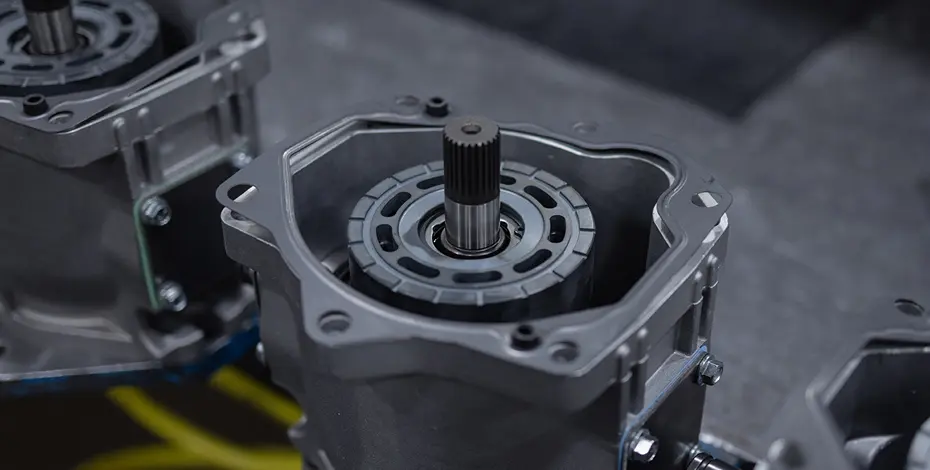
A fluid-power motor is a device that converts the energy of pressurized fluid into rotary motion and mechanical force. A hydraulic motor operates in the reverse sense of a pump, although fluid-power motors are very similar to pumps in their design and operating principles. A good understanding of pumps therefore helps in understanding fluid-power motors. Motors are used in many fluid-power applications.
In hydraulic power drives, pumps and motors are connected through suitable lines and valves to form a hydraulic transmission. The pump, often referred to as the A-end, is driven by an external power source such as an electric motor. It supplies pressurized fluid to the hydraulic motor, or B-end. The hydraulic motor is driven by this flow and transfers rotary motion and force through a mechanical connection to perform work.
Fluid motors may have fixed or variable displacement. Fixed-displacement motors provide a fixed displacement per revolution, with motor speed varied by controlling inlet flow. Variable-displacement motors are constructed so that the working relationship of their internal components can be adjusted to change displacement. Most motors used in fluid-power systems are fixed-displacement types.
Displacement Type
Although most fluid-power motors are capable of rotating in either direction, some applications require rotation in only one direction. In such applications, one motor port is connected to the system pressure line and the other to the return line. Flow to the motor may be controlled by a flow-control valve, a two-way directional-control valve, or by starting and stopping the power source. Changing the flow rate to the motor changes motor speed.
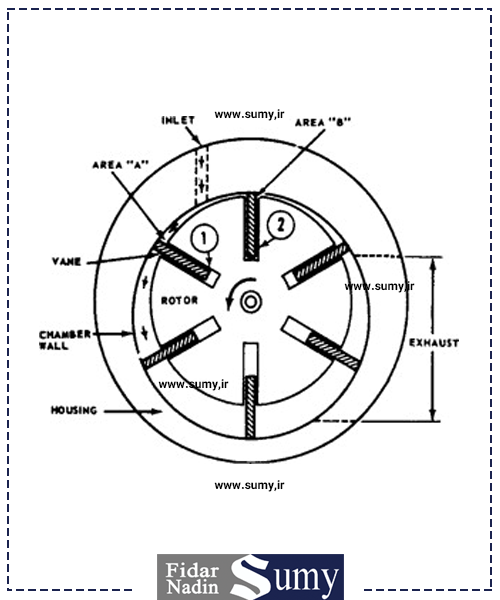
This motor operates on the principle of differential areas. When pressurized fluid is directed to the inlet port, pressure acts equally in all directions. Because area A is larger than area B, the rotor turns counterclockwise in the example described by the source. Each vane successively moves through positions 1 and 2, causing continuous rotor rotation. The potential energy of the hydraulic fluid is thereby converted into kinetic energy in the form of rotary motion and force. Many vane motors can rotate in either direction, with the two ports alternately serving as inlet and outlet.
Piston-Type Hydraulic Motor
Piston motorsare among the most widely used motors in hydraulic systems. Their construction is essentially similar to hydraulic piston pumps, except that they convert hydraulic energy into rotary mechanical energy. See the figure below:
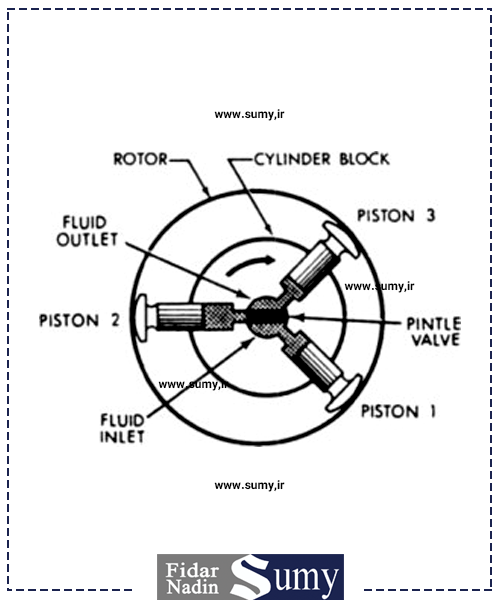
Fixed- and Variable-Displacement Piston Hydraulic Motors
The most common hydraulic motor is the fixed-displacement piston type. Some equipment uses a variable-displacement motor where a very wide speed range is required. Although directional-control valves are used to control some piston motors, they are often combined with variable-displacement pumps. This pump-and-motor combination is used to transmit power between a prime mover and a driven element.
Applications of Piston Hydraulic Motors
Hydraulic transmissions may be used in applications requiring controlled speed or torque drives.
Advantages of Hydraulic Power Transmission
The advantages of hydraulic power transmission compared with mechanical power transmission include:
- Fast and easy speed adjustment over a wide range while the power source can operate at a more constant and efficient speed.
- Fast, smooth acceleration and deceleration.
- Control of maximum torque and power.
- Smoother reversal of motion.
Motor Operation in Fluid-Power Systems
In most fluid-power systems, the motor must be capable of supplying drive in either direction. In these applications, the ports are referred to as working ports and alternately serve as inlet and outlet ports. Flow to the motor is usually controlled either by a four-way directional-control valve or by a variable-displacement pump.
Classification of Fluid Motors
Fluid motors are commonly classified according to the internal element acted upon directly by pressurized flow. The most common elements are gears, vanes, and pistons. All three types can be used in hydraulic systems; the source notes that vane-type motors are the common adaptable type for pneumatic systems.
Gear-Type Hydraulic Motor
The operation of a gear motoris shown in the figure below. Both gears rotate together, but only one is connected to the output shaft. When pressurized fluid enters chamber A, it follows the path of least resistance around the inner surface of the housing. This flow forces the gears to rotate as shown. Fluid then passes through the outlet port to the return line. The rotary motion of the gears is transmitted through the connected shaft to the driven unit.
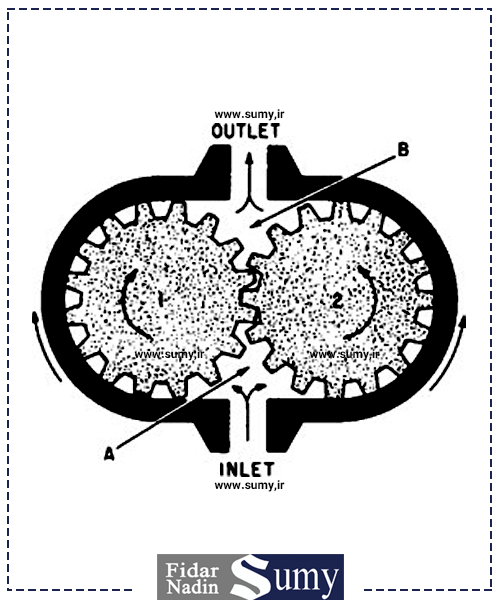
The motor shown in the figure above operates in one direction in the illustrated arrangement, but it can operate in either direction. To reverse rotation, the inlet and outlet functions of the ports can be exchanged. When fluid is directed into chamber B through the opposite port, the gears rotate in the opposite direction.
Vane-Type Hydraulic Motor